Tom Bean, TX: Pokemon Center of the Universe?
February 8, 2010 by Ginger Mynatt
Filed under Front of the Book, Texoma LifeStyles
Three times a year, participants gather at the community room in the Tom Bean City Hall to test their skills in the game—or is it the art?—of Pokémon.
(Editor’s Note: This seems a good spot for a time out to explain what Pokémon is for those who don’t know, but we will pass. There is a detailed explanation on the Web from Wikipedia that is so simple a ten-year-old can understand it. After reading it, we suggest you find a ten-year old to translate and then move on.)
Spring and fall tournaments are called “Battle Roads,” but the December games are “City Championships.” The word “city” is misleading, as it applies to a large region, the next step above local contests on a player’s road to the nationals. This year on December 12, twenty-six contestants from Fort Worth to Oklahoma showed up in Tom Bean, trying to win enough points to move forward to state-wide competitions. Others, including contestant’s family members were there to play for fun.
Justin Burch, 10, the newest player in the mix, came with his mother from McKinney. Jacob Tamm, a middle school student from Frisco, came with his dad. Jacob is an expert, having won fourth place among four hundred entrants in his level at the nationals in St. Louis last summer. Beth Copeland, from Mustang, Oklahoma, came with her boyfriend. She was the only girl competing. Each of the above players represents a different game level: junior—age ten and under, senior—eleven to fifteen, master— sixteen and up. Their points and ranks, along with those of all the other players across the nation are recorded in a data base in Washington D.C..
See more photos from the tournament.
So how is it that the Tom Bean City Championship is one of the best known and best-rated tournaments in the area? Randy Blades, a parent from McKinney, explained. “Tom Bean is one the best run, best attended in the state. Because it is close to Oklahoma, we get people from there, as well as people from Dallas, plus all of North Texas, so the competition is really good.”
“Tom Bean is our favorite place to go,” said Darryl Tamm. “You get off the freeway and go through rolling hills. The [community center] room is nice—clean with good bathrooms. The yard outside is a plus because the kids can play football and let off steam in between rounds, and there’s this little market [KC Food] that is also a restaurant that has pizza better than you can get any place else.”
Shane Potter, a Pokémon judge from Dallas, has no doubt who is responsible for Tom Bean’s Pokémon success. “You have to give the person who runs it the credit and that’s Boyd Highlander.”
Highlander started playing the game to have something to do with his son Josh. “I think that’s how most dads get into it. At first I read while he played. Then I started to play in pre-release tournaments so Josh could get more cards. Finally, I entered a premier tournament so lesser players could have someone to beat. Then three years ago, Richard Collingsworth asked me to start a city level tournament here in Tom Bean. This is our eleventh one. Our average tournament hosts forty players.”
The next question is what makes Pokémon so appealing that parents or players will drive long distances, buy expensive cards and spend hours playing? It’s a surprisingly challenging game. Just watching the long rows of tables with heads from young to old bent over brightly colored cards won’t provide enough information to figure it out. It is clear that the trading cards are everything. But it is also clear that each card has a plethora of information that must be assimilated and acted upon with long-term consequences in mind.
Jayna Burch said she was happy when her son, Jason, started playing Pokémon. She thought it helped build strategic skills, and it was nice that “he enjoyed something that is completely harmless. I don’t have to edit it.”
“I like to use strategy and math,” said ten-year-old Christopher Jordan. “I like that it uses your brain.”
Alec Noah, a teenager from Plano with a notebook full of plastic-protected cards explained a gold-hologram card. “Claydol’s a staple. It is played in nearly every deck even though it has no attack points. It has eight hit points, and it has Cosmic Power. It will allow you to renew your deck by putting current cards on the bottom and taking new cards from the top.”
Got that? No. Don’t try reading it again, it won’t do any good. (See the editor’s note in the first paragraph and find yourself a ten-year-old.)
Each of thousands of cards in various suits has a different attribute, making Pokémon a complicated, thought-provoking game, a game that parents and children can play together and not have to go any farther than Tom Bean, Texas, to learn how.
Learn more about Pokémon competition by visiting the Official Website.
Doll House: Mama Muriel’s Doll Museum
December 25, 2009 by Kathy Floyd
Filed under Texoma LifeStyles
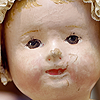
They take your breath away when you first see them, the hundreds of dolls lined up inside Mama Muriel’s Doll Museum in Leonard.
Dolls of all types imaginable wait in glass cases to catch your eye. Then, out of all the painted faces, you spy a certain doll, one just like a favorite you played with as a child, or one you desperately wanted but did not have, and memories long buried deep come flooding back.
That is the spell cast when you visit Muriel Bonds’ dolls. Even the most jaded visitors will find something that takes them back to a more carefree time. Murriel’s grandson, Jackie Bonds, can attest to that. When he noticed that work had stopped on installing glass in the museum’s cases, he found the burly workmen reliving their childhood with G.I. Joe. The museum is a wonderland for anyone, male or female, who has ever had a doll or wanted a doll.
Reliving a memory is practically guaranteed. “The people who come through here, there’s always some emotional thing that will strike them,” Bonds said, speaking of the museum, which he built, and the collection amassed by his grandmother Muriel Bonds, who still visits on outings from the Leonard rest home where she lives.
Dolls dating to the mid-1800s have found a home at Mama Murriel’s (Mama Murl to her family). The most famous doll in the world, Barbie, is here, represented in different reincarnations as she changed through the years. Her little sister Skipper and friends Ken and Midge are with her too. Chatty Cathy, Crissy dolls, Mattel’s Liddle Kiddles—dolls that have become cultural icons—are preserved at Mama Murriel’s. Also in the family are antique German and French dolls, and the collectible series dolls such as Madame Alexander, Effanbee, and American Girl.
Want to see more of Mama Muriel’s Dolls?
Click here to see photographer Jacki Lee’s fascinating photos.
The list of residents at Mama Muriel’s includes not only the stars of dolldom, but a who’s who of names from history and the celebrity world. A selection of American First Ladies, along with Susan B. Anthony, Princess Diana, Donny and Marie Osmond, Brooke Shields, Farrah Fawcett, John Wayne, Mr. T, Groucho Marx, and Michael Jackson all have spaces in Murriel’s glass cases. Numerous Shirley Temples, complete with curls and dimples, model costumes from her movies. And Miss Scarlett O’Hara from Gone with the Wind is on hand, straight from Tara in her moss-green dress made of curtains. Sets of dolls commemorate the 1934 birth of the Canadian Dionne Quintuplets.
Not all the dolls are of the cuddly playful juvenile variety. Petite porcelain ladies recline on ash tray beds, and with the slightest nudge, wave their legs in the air. The museum includes what Bonds thinks may be one of the world’s largest collections of half-dolls, a thousand tiny torsos of dainty ladies only a few inches tall. Half-dolls were dresser ornaments or lamp finials, or they topped pin cushions, ring boxes, powder puffs, barber’s brushes, or tea cozies, or they served one of a dozen other uses. Head vases, many made by the world’s finest china makers, are another subcategory of Mama Muriel’s dolls.
From the world’s smallest Kewpie Doll to a Barbie doll dressed in a flamboyant Bob Mackie costume or an old china doll whose painted face is nearly worn off by a child’s hands, Mama Muriel loved them all. But if she did pick a favorite, Bonds and his mother, Lenora Moore, both agreed it would be the Terri Lee dolls. They began production in 1946 and were made into the 1960s, with some special issues and reproductions still made today.
Muriel also collected the doll furniture, clothes, and accessories that are on display. Many dolls wear clothes that she made. As Bonds will tell, his grandmother wants all her dolls to be decently clothed. A “nekkid” doll currently displayed to show its jointed parts always brings dismay from Murriel when she visits. Bonds said that more than forty cases of dolls are stored because they do not have room to display them. He rotates the dolls so that every one gets its turn in the showcase. It took four months to place the dolls into the display cases.
Have you visited Mama Muriel’s?
Share your visit and what you saw with our readers.
Leave a comment below.
Bonds and his mother, Lenora Moore, walk between the glass cases and point at different dolls, each with its own story. One was a gift of gratitude to Muriel for sitting with a distraught mother. Bonds and Moore have many “Grandmother” stories to tell, such as when they were moving the dolls to the museum from her former home, and Murriel insisted that they each be carried in the back seat of a car. Loading the dolls into a truck was not satisfactory. “Moving the dolls was a big ‘to do,’” Bonds said. And there is the Audrey Hepburn Breakfast at Tiffany’s doll, with a matching coat and purse. Bonds said his grandmother turned to him with all seriousness and said, “She’s been shopping.”
“Grandmother had a great sense of humor,” Moore said. “She just loved dolls,” Moore said. “She enjoyed dressing them. She enjoyed looking after them. She’d talk to them. These were her babies.”
Muriel was born to sharecroppers in 1917 in Red River County, the only girl in a family of brothers and boy cousins. In a photo of her in the early 1920s, she sits with dolls gathered around her, a hint of what her future held. Her present-day collection did not begin until the mid-1960s, after her retirement from the Red River Army Depot.
Perhaps as a result of a poor childhood, Muriel did not use the family household money to purchase her dolls. She earned extra money for them by quilting, crocheting, or making and selling other crafty doodads. For Bonds, the most memorable of her crafts were the beer can hats of the 1970s. Muriel recruited Jackie and his sister Pamela to collect the cans. “Oh, she had a heyday with beer can hats,” Bonds said. “She’d sell those things at $5 apiece, and I’ve seen her sell fifty or sixty a week. She could pump ’em out.”
Muriel’s husband James encouraged her collecting and would often surprise her with dolls that she did not buy because she thought they were too expensive. One of the most extraordinary aspects of the museum is that Muriel acquired all these dolls before the days of the Internet, locating rare and antique dolls through doll clubs and a network of fellow doll-lovers.
The idea for a museum came about after James Bonds died in 1995. Muriel worried about her dolls and where they would spend their days after she was gone. Bonds reassured her that the dolls would be cared for. He talked of building a place to keep them, and then realized that she wanted the life-sized doll house built while she was still around to enjoy it. “She was so upset about what would happen to her babies,” Moore said. So Bonds built his grandmother a place to shelter and show the dolls, and to shelter her, just a holler away from his own home. After the museum’s completion, she lived in a room there until she moved to Leonard Manor. Now, if she is home for a family gathering, the others may find her roaming through the museum aisles on her scooter.
Since building the museum, Bonds has had no regrets. Now others can appreciate the time and energy that Murriel spent in gathering her collection. “I understand the passion of collecting,” he said. “Sharing with others is the fun of collecting. Collections are worthless if you can’t share them.” And he sees the museum as a tribute to his grandmother as much as it is a place to house her collection.
More than six hundred visitors pass through Mama Muriel’s each year. Doll clubs, groups from retirement homes, children’s groups, even people from as far away as Estonia and Sweden have come to Leonard to see the dolls. Bonds said that most are doll collectors themselves and, “They always leave happy.” And sometimes they leave something behind. Moore picked up a ragged baby doll out of a bowl just inside the museum doorway. Neither she nor Bonds knew where it came from. Someone must have left it in hopes of it finding a good home.
Mama Muriel, now 92, still recognizes her family, but may quickly forget that they have visited. She remembers her dolls, even those she had as a child. And she remembers that her parents must have sacrificed to buy dolls for their little girl. “When I was little I thought dolls were a must,” she said. “I’m sure it hurt their pocketbooks, but they never discouraged me.” Several dolls have managed to find a way to Mama Muriel’s room so she will not be alone, and she knows they are with her. “I love my dolls. They’re like friends to me. They’re pretty.” She did not remember her favorites but said, “I liked different ones that stood out from the others.” And as an aide came in to take her to supper, she said, “I’m not bragging, but I’ve got hundreds.”
Yes, Mama Muriel, you do, although thousands is more like it, and don’t worry about them. They are being well taken care of and even more, they are bringing warm memories to others.
Mama Muriel’s Doll Museum
5285 FM 1553
Leonard, Texas
(903) 587-3655
Open Fridays and Saturdays 10 am- 4 pm
Click here for map and directions.
Yea, That’s the Ticket!
December 21, 2009 by Marcus Vela
Filed under Texoma LifeStyles
Laura Barajas has patrolled downtown Sherman for ten years, armed only with a radio and her formidable chalking stick. She wears a grey Sherman P.D. t-shirt, blue shorts, and a farmer’s tan. She walks about a mile on each of her routes, taking approximately eight thousand brisk steps a day.
Barajas writes an average of ten tickets daily and has yet to work a shift when she hasn’t had the need to write a citation. When she isn’t nabbing parking violators, she works administrative jobs at the police station. Barajas is an excellent amateur angler and often exchanges fish tales with Dale the barber, on Travis Street, over a glass of orange juice.
Q&A interview by Marcus Vela
Texoma Living! Staff Reporter
What is your official title?
Parking Enforcement Attendant. A lot people refer to me as a meter maid, even though there are no meters, but it’s because the city used to have them. Some people call me Officer Laura. It doesn’t bother me when people do that, but I am actually a civilian. I figured I get chewed out enough just being a parking attendant, without being an officer. It’s part of the job I guess, but I do enjoy what I do. The job is very relaxing. Something different happens every day.
How long does it take to do a route, and do you walk the same one each time?
It is about a forty-five minute walk. I take different routes, so people won’t get used to me going a certain way. I set checkpoints on my route so I can keep up with times. If I hit one at 9:04 in the morning, on my second route I will try to get there by 12:20. I’m not perfect, so I try to give people a fifteen minute grace period before writing a time violation. I don’t want to cheat anyone.
Is it difficult giving someone a citation?
Writing a ticket is a tough decision, especially when I get to know people, but they understand it’s my job.
What is the most common ticket you write?
Parking over the line. People don’t realize they’re over the line and actually taking up two spaces. A lot of the time people think parking over the line is no big deal, but when there are only ten parking spaces, and two people take up two spaces each, there really isn’t any reason for that. On occasion, if someone is parked over the line I will write a warning. If you’re way over, then you’ll get a citation. It’s just a decision that I have to make. Second most common is the three hour parking violation.
Do you ever give someone a break?
Not on time violations. But if I see someone pull up, and they park over the line, I will show them that they are parking over the line, and I will explain to them that they could get a ticket. A lot of the time I will start to write a ticket and people will run over yelling, “Wait, I’m coming, I’m coming,” but if I didn’t continue to write the ticket, then everyone would come out running. It’s hard to write that ticket sometimes because I know they are about to leave, but it’s my job.
Do you wear out a lot of walking shoes?
Yes I do. The Sherman Police Department pays for them. Each pair lasts about four months. I try to get them resoled every once in awhile, but I do go through quite a few shoes. Having actual walking shoes makes a huge difference. It’s real important to have good shoes. The girl that did my job before me did it for fourteen years, and she quit because her feet started to hurt her. When I took over she stressed to always have good shoes.
Anything unusual happen on your watch?
The most unusual thing was on Crockett Street. I went to mark the tires, and there weren’t any. It was sitting on cement blocks. Later I found out that the driver was renting the tires and had had them repossessed. I kind of laughed, because I was like, I know someone is watching me right now, thinking “Is she going to mark the rims?” Shoot, I thought, I’ll give this driver a break.
What’s Your Parking Ticket Story? Leave a Comment for this Story.
Dorothy Hayes: Dollmaker
December 20, 2009 by Kathy Floyd
Filed under Texoma LifeStyles
In a small shed behind Dorothy Hayes’ home on Sherman’s west side, tiny clenched fists poke up among empty, eyeless heads. Assorted sizes of arms, legs and other body parts line shelves along the wall. A scene left over from Halloween? No, something much more innocent. Hayes’ home is a one-woman doll factory.
Hayes shares her house with grandchildren, great-grandchildren and at least 250 dolls. That is not the remarkable part. She made all those dolls and the clothes on their diminutive porcelain backs herself.
She has been a seamstress since she was a child, and in searching for something to fill her time after retirement from Texas Instruments, she combined sewing with her love for dolls and found the perfect partnership. In the past ten years, the seventy-four-year-old Hayes has learned the art of pouring liquid porcelain in molds to shape heads, arms, legs and other dolly parts. The porcelain is layered until it reaches the right thickness, and then baked in a kiln. After the baking, Hayes rubs the pieces with fine sandpaper until they are as smooth as a real baby’s skin. She gives her new friends eyes and hair and then paints their faces at her dining room table, one that belonged to her late husband’s grandparents.
Some dolls are replicas of famous people. You’ll recognize John Wayne, Shirley Temple and Princess Diana in the collection. Others, Hayes has painted and dressed to look like celebrities such as Cher or Marilyn Monroe.
Making the clothes is her favorite part of the process because it allows her more creativity. Some of the dolls’ outfits she makes are quite elaborate. One of her favorites, Wedding Day Shay, wears a white satin dress hand-beaded with tiny pearls. Another doll sports a winter coat of green velvet with a beret to match. She displays the dolls wherever she can find a spot. Like a full house of people at a fun Christmas party, dolls several rows deep fill up Hayes’ living room and spill into bedrooms and line shelves on the walls.
Hayes has made dolls for her children, grandchildren and other family members. She would sell some of her dolls, but does not think she could recoup what it took in time and effort to make them, so for now, they have become part of the household. What drives Hayes to keep on making new dolls? “It’s my hobby,” she said. “I enjoy doing it. And because I like dolls. They’re just pretty.”
See more photos of Dorothy Hayes’ dolls taken by Jacki Lee.
100 Toy Soldiers $1.25
December 19, 2009 by Dan Acree
Filed under Texoma LifeStyles
Milton Levine was just a few years out of the military in the mid 1940s. Like many young men returning from WWII the New Yorker was searching for his place in post-war America. He read in Kiplinger’s Letter that there were several ways to make big money—two suggestions were “plastic toys or bobbie pins.”
Levine’s real success would come later when he imagined another idea that would sell into the millions and become a mail-order cult classic. But in 1946, his main goal was to enter the “exciting world of plastics.”
Levine formed a partnership with his brother-in-law, E. Joseph “Joe” Cossman and the pair set out to form a mail-order toy company. E. Joseph Cossman & Company (aka Cossman & Levine Co.) was launched. The pair’s business plan was based on the prospect of a post-war baby boom and a manufacturing upswing in the U.S. Since 1912, Cracker Jack had packed small novelty toys in their boxes and that’s where the partners began their search for a manufacturer to make their toys. NOSCO Plastic of Erie, Pennsylvania, was a supplier of plastic toys to Cracker Jack and that’s where the first “flats” were made.
While no one can agree on a time line, 1950 seems to be the year the mail-order business was in full production.
Initially the small print ads (usually 2-inches x 2 1/4-inches) were placed in local newspapers throughout the southern New York area and later across the nation. The toy soldiers ads were a phenomenal success.
Allow 6-8 Weeks (maybe more)
Sometimes weeks or months after ordering, the postman delivered a package of flat, styrene-based, hard plastic pieces in a marbled green color mixed with varying shades of black or white. Many of the figures were detailed with rank stripes or branch logos on their shoulders.
Levine credits the success of the business as having had “the right product, at the right time, at the right price.” At $1.25 (later $1.98) every child with a minimum deposit in their piggy bank could scrape up enough money to order “100 Toy Soldiers Packed in a Footlocker.” In fact, the footlocker did not arrive for nearly a year, but its addition doubled an already thriving mail-order business. Cossman & Levine hired a staff of women to open the huge amounts of mail that arrived each day. Before long there were daily visits to the bank to deposit thousands of dollars in one-dollar bills and bags of quarters.
Good News Travels Fast
Soon, competitors were selling similar items with very similar advertising. The pitch was always the same: a lot of toys for a low price. Mastercraft, a Boston company, sold “100 Toy Soldiers for $1.00,” but did not include the important “footlocker” that held the Cossman & Co. playsets.
It is believed that Levine and his brother-in-law either set up a number of separate companies (all with East Coast P.O. Boxes) or sold wholesale to other mail-order companies. New names with new mailing addresses began to appear by 1951 and endless variations of the offer were appearing.
Were you one of the boys who waited weeks or months for a “footlocker” full of toy soldiers?
Share your story with our readers. Click on Leave a Comment.
Cossman also sold a popular “100 Cowboys & Indians” set. This set of western figures arrived in an illustrated box with a unique die-cut “pop-out, build-it-yourself” diorama. The plastic figures were typically flat but came in bright red, yellow and blue colors.
“3 Ring Circus” was a popular offer that featured a pop-out center ring where the animals and performers could be arranged. Perhaps the pink and purple circus set was expected to attract little girls with imagination and a piggy bank. Levine has been quoted as saying the circus set did not do well.
Mail Order Mania
By 1952 there were dozens of compet-ing ads. Most collectors assume the majority were in some way related, since the products were nearly identical.
In addition to the flat hard plastic pieces, new 3-D figures made of soft, molded plastic began to appear.
Sometime in the mid-50s ads were placed on the back pages of comic books and soon became icons of that decade. Millions of play sets were sold including these:
- 150 Civil War Soldiers ($1.49)
- 30pc Indian Village Kit ($1.00)
- 132 Roman Soldiers ($2.98)
- 200 WWII Soldiers ($1.98)
- 204 Revolutionary Soldiers ($2.50)
- 162pc Viking Attack ($2.00)
- 104 Kings & Knights ($1.49)
- 116 Planes of All Nations ($1.25)
There was also a line of wargame sets that included the plastic figures accompanied by full-color fold-out play mats, accessories, and rules of play.
- Woods Edge ($1.00)
- Tank Trap ($1.69)
- Task Force ($1.69)
- 132pc Fighting Ships ($1.50)
- 196pc Blast Off Space Game ($1.98)
- 146pc Daniel Boone’s Trek
- to Ol’ Kentucky ($1.50)
The Evolution of Toy Soldier Ads
The comic book ads produced spectacular results and the toy sellers realized that a little packaging upgrade—at least in the print ads—might bring even more orders. Russ Heath was one of the preeminent illustrators of the time. His work for DC Comics and other publishers was well-known for its style.
His boss came to him with a small pick-up job to design an ad for an advertiser. Heath’s creation of the Revolutionary Soldiers ad set the standard for all future toy soldier offers. Of course, his ads worked like magic. Heath’s imaginative styling added the action and adventure element that had been missing by just showing the plastic figures set up in rows.
Cossman & Levine made a lot of money with their idea. But Levine tired of the game and started looking for a new product. The fact is that Levine and his brother-in-law directly hawked toy soldiers for a little more than two years. Their new idea was going to be even bigger. Levine’s brilliant new invention? Completely ridiculous, some thought. Who was going to buy a mail-order live ant farm? In the early 1960s Milton Levine bought out Cossman and Uncle Milton’s Toys was born.