Chasing Bootleggers in Texoma

February 16, 2010 by Willie Jacobs  
Filed under Texoma Heritage

The bootlegger flinched twice, once when I jacked a shell into the chamber of the sawed-off 12-gauge and again when I jammed the muzzle against his left ear. To me, the backward-forward action of the shotgun was a smooth schnick-schnick. To him, it must have sounded like thunder.

The smell in my nostrils was fear and oil fumes. He was scared. I was scared. The old Ford was puffing blue smoke through the floorboard. I had the side of the gun pressed against my cheek, and the moisture on my face and the shotgun was my sweat.

Even in the dimness of the dome light, I could see beads of perspiration on the face of the bootlegger behind the wheel. His chin was bleeding from landing face down in the gravel road when he had fallen in his escape attempt. His ear was oozing blood, but the wound was not intentional. I was neither that tough nor that mean. He had tried to get out of the car at the same second I decided to get closer. The collision of muzzle and head almost took off his ear lobe, and he never moved again. His hands were frozen on the steering wheel. His eyes moved neither right nor left. “I’ll be good! Don’t shoot me!” he said.

I heard a “pop, pop, pop” and saw three quick muzzle flashes a few yards away, as the detective who had given me a ride earlier that evening fired his snub-nosed .38 detective special in the direction of a fleeing Lincoln. The second bootlegger was getting away.

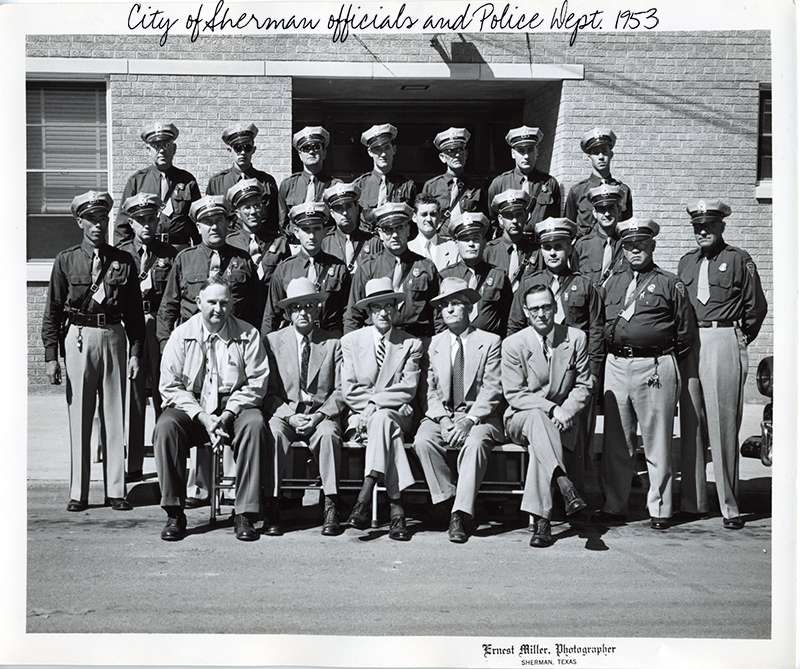
The year was 1956. Bootlegging was the number one crime in Grayson County and a way of life in Sherman and Denison. Thirsty drinkers were willing pay for their liquor, and a bootlegger could double his money hauling hooch up US 75, the two-lane ribbon of concrete that connected Sherman to Dallas.

I was a twenty-one-year-old rookie police reporter when I hitched a ride with Johnny Garmon, a detective with the Sherman Police Department and a friend of mind. It was a little after midnight on a Saturday when he picked me up at the front door of the Sherman Democrat on the southeast corner of the courthouse square.

We went looking for a pair of chicken fried steaks out on the Denison highway and settled for a pair of bootleggers and some gunshots on Gallagher Road. Nothing like that had ever been mentioned in Journalism 101 at North Texas State.

We were in an unmarked police car. A man driving a near-ancient, smoking, oil-burning old Ford passed us on Walnut Street, which was one way and ran north. The car’s front end was high, and the rear bumper was nearly dragging the concrete.

Garmon recognized the man as a local bootlegger. “That guy’s settin’ low with a load of whiskey,” he said, as he stepped on the gas. When the old Ford turned onto Loy Lake Road, Garmon turned his headlights off and followed several hundred yards back.

When the Ford turned east onto Gallagher, Garmon stopped in the dark. We were south of the spot where Loy Lake Road crosses US 82 today. There were no houses and no trees in the area in 1956, nothing but Johnson grass and a few oil wells. The last Loy Lake Road address listed in the 1956 Sherman city directory is 2626, today’s location of First Texoma National Bank.

The detective pulled out a pair of binoculars and peered into the night. There was nothing to block his view when the Ford met another car driving west. They drove past each other, stopped, and then backed up until their rear bumpers were almost touching. The two cars stopped again where Northridge meets Gallagher today.

Garmon flipped on his lights and drove slowly past the two cars. Two men, one black and one white, were moving cases of whiskey from the old Ford into the huge trunk of a new Lincoln. Both engines were running. The men didn’t even look up from their work as we rolled by. When we got to US 75 (now Texoma Parkway), Garmon turned around and turned his lights off again.

Then it got serious. Garmon reached under the front seat and handed me a sawed-off 12-gauge pump. “You are duly deputized. It’s loaded. You’ll have to put one in the chamber. You take the black guy, and I’ll take the white guy.” Then, almost as an afterthought, he added, “You do know how to put one in the chamber, don’t you?” I nodded, too scared to speak. My dad had first put a shotgun in my hands when I was about ten years old.

The bootleggers were so busy with their chores that they never noticed that our car had rolled quietly up on the scene. Then Garmon stepped out, pistol drawn, and said, “Hands up, and stand where you are.”

The black man made the first break, but I was standing on the driver’s side of his car. He stumbled, swore as he fell face first in the gravel, scrambled up and got into the car. He didn’t get the door closed before I said, “Don’t move.” That’s what I said because that’s what they said in the movies in situations like that.

The Lincoln was between Garmon and the white man, and he didn’t even close his door as he dove into the car and gunned it, sending a shower of gravel over both of us, as he left the road and circled south and back east through the Johnson grass, headed for Denison.

Garmon moved into the waist-deep grass, stood in one place, and pivoted as he fired his snub-nosed .38 special three times. The Lincoln never slowed, as it careened out of the field and bounced through a ditch back onto the gravel road. The trunk lid, which the bootlegger did not have time to close, was flapping, but no whiskey was lost.

The detective jerked the bleeding prisoner out of the old Ford and into our back seat, and we gave chase. The police car was no match for the bootlegger’s ride. It choked down and cut out at about eighty, and the second car got away clean. Well, not exactly clean. Tuesday morning, Fort Worth police found the Lincoln on a used car lot. It had three bullet holes in the trunk and long stalks of Johnson grass in the frame.

I didn’t sleep much that night after I got back to my garage apartment on Ross Street. Was what I had done legal? Garmon had said it was legal. Had either of the two men been armed? Would a black man with a big scab on his left ear come looking for me when he got out of jail?

When my dad was teaching me gun safety, he had said, “You don’t get to be dead but once!” I knew what I had done that night was dangerous, but it took a while for the events of the evening to sink in. It was a night I would never forget, and friend Johnny Garmon helped etch the story in my mind and in his when he laughed and told the story in my presence, probably a dozen times, to police friends or anybody who would listen.

Burglaries took over the top crime spot in Grayson County in 1960, after a liquor election in which Denison voters opted to go wet and buy booze at home. Before the election, proponents declared that any person ever convicted of the illegal transportation or sale of alcoholic beverages would not be allowed to obtain a liquor sales license. The man in the Lincoln was one of the first to be approved, and he prospered in the liquor business for many years.

Peddling whiskey was not a prison offense. There were just fines, maybe a night in jail. A bootlegger behind bars told me, “Fines is a business expense. You pay income tax. I pay fines. I’ll be out and selling again tomorrow morning.”

B. F. Wade, Sherman resident in his sixtieth year of law enforcement, most of it with the Texas Highway Patrol, chased his share of bootleggers. Wade said that most arrests came from informants’ tips, and the best informants were Dallas liquor stores. “The stores always had a man watching the competition,” he recalled. “If a bootlegger bought from one store, the other store would tip off the highway patrol.”

There was also a kickback system, which Wade explained. If the bootlegger paid 10 percent of his projected gross up front to the liquor store where he was buying his booze, he had a guarantee that the store would not call the highway patrol. It was the old protection racket, “pay me and I won’t tell.”

For a while during the mid fifties, Wade was the only highway patrolman in Grayson County, and the bootleggers knew it. They would call his home at night. If he answered, they knew he was not on patrol, and they would make a run. If he did not answer, the bootlegger usually waited until a safer time.

In the movies, the bootleggers always drove souped-up, cars and the law had a hard time catching them. Not in Grayson County, Wade said. “They drove stock cars, and they were not any faster than our patrol cars. Plus, we had the experience of knowing how to drive fast better than they did, and we knew our roads better.” In 1956, he drove a new Ford.

He said that he never shot at a bootlegger, and, as far as he knew, no bootlegger ever shot at him. But did some of them have weapons? “They were outlaws,” he said. “I’m sure they did.”

It was a long drive to a legal drink back then. Even Oklahoma was dry, well, sort of. Across the Red River, they sold a legal low-alcohol beverage called “near beer.” Signs in stores explained it. “No beer near here. Near beer sold here.” That was good enough for teenagers looking for a buzz, but not near good enough for serious drinkers.

J. D. Pickens, retired Sherman chief of police who still lives in the city, recalled two Durant brothers, regular Dallas customers, who owned identical Oldsmobiles. When the police chased them, one Olds served as a decoy, while the other one hauled the booze. They had no qualms about swapping license plates between the two cars. Wade remembered two identical white Cadillacs that played the same game.

Bootlegging took more law enforcement time than most crimes, and it was a game of hide and seek for the law and the lawless. Most bootleggers hid their stash in their homes, and they hid it well.

One man, who was a carpenter by trade, built an elaborate system with a secret door. When a heavy, stiff wire with a crook on the end was inserted into a hole in the bottom of a kitchen cabinet a secret panel would open and display the entire inventory of illicit booze. Years later, long after his bootlegging days had ended, the owner of the cabinet was gunned down inside a shower stall where he was working.

In another case, the policemen had just about given up in a search in a particular house, when J. D. Pickens noticed that the screws inside a bathroom medicine cabinet were not tight. He loosened the screws even more, and, when he pulled the cabinet out of the wall, a pint of whiskey popped up. The bootlegger had a homemade vending machine between the walls with a spring under the bottles. When one pint was taken, another came to the top.

One enterprising bootlegger also sold minnows from a concrete tank between his house and the street. A hose on the ground near the tank rang a bell when a car passed over it. If the bell rang twice, the front wheels and then the back wheels rolling over the alarm, the man went out and sold a bucket of minnows. Drivers in the know drove over the alarm once and then backed over it again, causing multiple rings of the bell. They got a different service.

When the sheriff’s office busted this fishy business, Sheriff Woody Blanton sent the minnow man’s fingerprints to the FBI in Washington. It was not routine for minor offenses, but Blanton’s office had just installed a sophisticated fingerprint system, and the sheriff wanted to try it out.

The response from the bureau was quick. The minnow salesman was wanted in Georgia, where he had been part of a mass escape from a chain gang and a guard had been killed. Although he did not take part in the killing, he was still a fugitive. Shortly after his escape, he had moved to Sherman and changed his name.

Extradition was stymied when a doctor testified that the man had a disability that would make him physically unable to go back to Georgia to serve out his original sentence or even face trial on the escape charge. When old-time lawmen tell the story today, some say he went back to Georgia, but was released after serving only a part of his prison term. Others say he never left Sherman before he died.

That minnow tank is still in the same place that it was in 1956, and some of the lawmen of that day are still swapping stories about chasing bootleggers, and some of the old bootleggers are still swapping stories about being chased. But, bootlegging? Well, bootlegging got killed at the ballot box almost fifty years ago.

History of the Bootlegger

Did you ever wonder about the term “bootlegger”? The term reaches back to at least 1889 as a reference to smugglers who carried illicit bottles of whiskey down the tops of their boots. It’s a colorful use of the language, not surprising as criminal cant often makes imaginative use of words to obfuscate the speaker’s true meaning. The illicit making, transporting and selling of whiskey if fill with such argot. Make it without a license and it’s “moonshine.” Logic suggests that the term comes working at night under the moon to hide the activity, but in parts of England, the term also meant “nothing of importance,” and that meaning may have been used by smugglers to describe their goods. If the man with a “thirst” couldn’t afford a jug, he could get a single drink at a “shot house.” With the ratification of the 18th Amendment in 1919, and the passing of the Volstead Act to enforce it, illegal bars became “speakeasies” as patrons would be warned by the bartender not to call attention to what was going on, to “speak easy.” The tipplers downed “bathtub gin,” made by “alky cookers” or tasted “the real McCoy” smuggled past the Coast Guard by “rum runners.” Down South, a illegal bar operating behind a legitimate business front was called a “blind tiger” or “blind pig” sold “white lightning,” “hooch,” or just “shine.” With the repeal of the 18th Amendment by the ratification of the 21st Amendment on December 5, 1933, control of alcoholic beverages— except for federal tax purposes— became a state matter once again, and the bootlegger became an agent of convenience rather than need. That’s what made the business a profitable one in dry Grayson County in the 1950s.

Editors note: Willie Jacobs, long-time Sherman resident, one-time rock-a-billy singer, long-time voice of Austin College football, and currently an insurance executive, started his career in Sherman in the mid 1950s as a reporter for the Sherman Democrat. At the request of Texoma Living! Jacobs recounted those days.

  • Share/Bookmark

Perrin Air Force Base: 1941-1971

The spring of 1941, Europe was eighteen months into a resumption of the hostilities that were little more than act two of the drama begun in 1914. The cast of characters was much the same, but the plot had developed twists that would bring revulsion to even those hardened by the carnage of the first bloodletting.

America, behind her two broad oceans, was at an uneasy peace. Despite the alarmist warnings of the isolationists and heartfelt rallies by groups like America First, few of those whose job it was to plan for the nation’s security felt the United States could much longer remain deaf to the tocsins of war.

The United States had no separate air force. Instead, the army and navy split the responsibility for military aviation. The land-based air arm, the U. S. Army Air Corps, was under manned, poorly equipped and hardly ready to take on the powers that threatened America. But that was changing. The country, the government, and the military had finally awakened to the need to rearm.

In 1939, led by General Henry Arnold, the Air Corps began an expansion that doubled the number of air groups from fifteen to thirty by the end of 1940. New airplanes to replace the aging bombers, transports, and pursuit planes were in various stages of design and testing. Now the growing air service needed fliers.

Congress had passed the first peace time draft in 1940 and extended it for another year in 1941 by one vote in the House of Representatives. Facing the draft and a year in the army, many young men looked to the sky as a better and more adventurous way to serve their country. There was no shortage of would-be aviation cadets. There was a shortage of places to train them.

Community leaders in Grayson County led by County Judge Jake Loy saw opportunity in the wide open skies over North Texas and in the spring of 1941 began talking up plans to bring the Army Air Corps to Grayson County. In March, Loy traveled to Washington, D.C. to meet with army and War Department officials and enlist the aid of the county’s representative in congress, Sam Rayburn of Bonham, recently elected Speaker of the House of Representatives.

Loy already had provided the government with a wealth of information about the proposed site and other factors on which the approval of the project would hinge, and he came home with more than just promises. In April, 1941, the Air Corps came to Sherman to meet with local officials and inspect a site for a proposed primary training school.

An Air Corps board met a month later and wrote a report recommending the establishment of the flying school. On June 10, Grayson County voters agreed to a $60,000 bond issue to purchase the land furnish railroad rights of way, highways and utilities to the field. The one dollar a year lease agreement between Grayson County and the United States Government was signed on July 1, 1941, and construction on the air field started that same week. Major Robert J. Warren, project officer and temporary base commander, arrived on August 9, and five enlisted men from Goodfellow Field in San Angelo came to Sherman ten days later.

Throughout the balance of the summer and the fall, work proceeded apace. By the first week in December, most of the buildings were either finished or nearing completion, most of the roads had been paved and the water tower had been finished.

On the first Sunday in December, there were 90 officers and 545 enlisted men on duty at the Grayson Basic Flying School. Half a world away, more than four times that number of American soldiers, sailors and Marines would die in the few terrible hours that introduced America to war.

After Pearl Harbor

Pearl Harbor moved everything, including the training schedules, up a notch or two. The first class of flight cadets arrived on December 16. The eighty-one would be airmen started training on December 22. On February 20, 1942, the field recorded its first fatalities with a crash that killed Cadet Quinto Perkins and instructor Cyril Van Valkenberg. The first class graduated three days later, moving on to advanced training at another base. That February 23 also saw the dedication of the field and the Grayson Basic Flying School officially became Perrin Field.

Colonel Elmer D. Perrin was a Texan, from San Antonio. He joined the army in 1917 and received a commission as a second lieutenant in the Air Service in July, 1918. Perrin stayed with the Army Air Corps following the Armistice and the end of the Great War in Europe. He became one of the aviators who dedicated their careers to proving the worth of military aviation under the leadership of an iconoclastic brigadier-general named Billy Mitchell.

In 1939 Perrin became the service’s representative at the Glenn L. Martin Aircraft Company in Baltimore. Perrin got the silver oak leaves of a lieutenant colonel in the spring of 1941 and was involved in testing and developing the B-26 Martin Marauder medium bomber. The Marauder was considered by many fliers a complex and difficult airplane to handle, with a high landing speed and overly sensitive controls. It was a controversial airplane from the time it was accepted by the army. History proved its worth, however, and the B-26 became the most significant medium bomber used in the European war.

On June 21, 1941, Perrin and A. J. Bowman, a civilian inspector, took off from Martin Field in a new B-26. Shortly after takeoff, the plane went into a sudden dive and crashed, killing both men. The Martin Company’s investigation of the crash suggested the plane had been sabotaged. Posthumously, the army promoted Elmer Perrin to colonel.

A year after it received its first class of cadets, Perrin Field had a troop strength of more than 4,000. This number dropped to the more normal 2,800 as more training facilities opened in Texas and other parts of the country. Mid 1943 saw cadet classes of 300 to 400 students, with more than 500 mechanics and technicians working in twenty-four hour shifts to maintain the BT-13s and AT-6s assigned to the field. By the close of the war in 1945, Perrin Field had graduated more than ten thousand student pilots, from the United States and five foreign countries, Brazil, Mexico, Guatemala, the Philippines and Ecuador. The base was also home to another group of foreign visitors, albeit unwilling ones, two hundred German POWs had made Perrin home while they worked on the Denison Dam.

Pilot training ended early in 1946, and even though an instructor school had been set up to maintain flight instructor proficiency, the base was deactivated in November and became a storage facility. When Perrin came to life again, on April 1, 1948, it was part of the newly created United States Air Force. It had a new name, Perrin Air Force Base, new blue uniforms and an old mission, basic single-engine pilot training. For a time, in 1952, the base offered advanced single-engine training and hosted training for the B-26 medium bomber.

Charles L. Brown, left, premed studies at Rice Institute in 1951 and volunteered for the U.S. Army. After training at Schofield Barracks in Hawaii, he served in Korea as an infantryman. “I liked the military, but I didn’t like carrying a pack and a rifle, so when I got an early out in 1954, I transferred to the air force,” Brown said. As an air force staff sergeant, he came to Perrin in 1963 to teach small arms marksmanship.

“I was an instructor at Lackland AFB before I came up here. I went through the USAF marksmanship school and worked down there for five years. I transferred up here because my wife was from this area,” Brown said. He spent three more years training shooters before hearing problems prompted him to change jobs. Calling on his premed training at Rice and the continuing education college-level courses he had taken while in the service, Brown became a pharmacy technician.

Brown left Perrin in 1968 and went to Turkey. He retired in 1972, came back to Sherman and went back to school to become a nurse. He worked for fourteen years at Wilson N. Jones Memorial Hospital as a nurse anesthetist. Today he lives in Sherman and is the proud owner of a restored Vietnam-era army ambulance. Brown and his big white truck with the red crosses can be seen regularly at parades and civic events.

1950 and Onward

The roar of jets cracked the skies of North Texas in the early 50s. Larger and longer runways were constructed, and T-33 trainers and F-86D Sabres could be seen on the Perrin flight lines. In 1962, the base became home of the 4780th Air Defense training wing and the largest deployment of F-102 Delta Dagger interceptors in the country. Utilizing nearby Lake Texoma, the Air Force set up a support and ejection training and survival school at the base. During its run, the school graduated more than eleven thousand air crew, including seventeen NASA astronauts. In all, forty-nine future space men passed through Perrin for one purpose or another over the years.

Ever encroaching civilian aircraft traffic from the new Dallas/Fort Worth International Airport that opened in 1974 and changing dynamics in pilot training ended Perrin’s life as a military base. On June 30, 1971, thirty years to the day after the Army Air Corps signed the lease to 1160 acres of Texas prairie for the Grayson Basic Flying School, the military’s involvement at the field ended.

When sixteen-year-old John Elkins left his home in Commerce, Texas, in 1945 to join the air force with his twin brother, he never thought he would end his career almost in his old back yard. “We finished basic training at Shepherd AFB in Wichita Falls and then went to aircraft maintenance school in Mississippi,” he recalled. “Then we went to Wheeler Field in Hawaii, working on P-47s.”

Elkins stayed in aircraft maintenance, rising to crew chief and moving from World War II fighters to the air force’s first jet bomber, the B-47 Stratojet, and then to its first supersonic bomber, the B-58 Hustler, at Carswell AFB in Fort Worth. “When I came back from a tour in Korea, I requested Carswell again and worked on B-52s. Our unit rotated in and out of Guam, and in 1965 launched the strikes against Vietnam.”

After a four-year tour in Oklahoma City as a recruiting supervisor, Elkins came to Perrin. “I worked about a month on the flight line as an aircraft maintenance control supervisor, and then the wing commander called me in and asked me to be the wing sergeant major. It was two years of the finest duty I ever had. About six months before I retired, we learned Perrin was closing, so I just went ahead and put in for my retirement. I retired on January 1, 1971.”Elkins stayed in Grayson County and now lives in Luella. He is one of the founders of the Perrin Field Historical Society and the Perrin Field Museum.

When Perrin Air Force Base closed, the property, by then more than 1,800 acres in size, reverted to the county, becoming the Grayson County Airport. In 2007 it was renamed North Texas Regional Airport – Perrin Field.

  • Share/Bookmark

Fashion’s Last Stand: Ringler’s Denison

December 25, 2009 by Shirley Clark  
Filed under Texoma Heritage

In the early 1930s, Louis Ringler emigrated from his native Poland to seek a new life in America. He met his wife Esther, who was Austrian by birth, in New York City, where they were married. When their son Herman was born, Louis and Esther decided to seek their fortunes outside the big city. A cousin, Oscar Tannenbaum, whispered “retail” in their ears and in the best tradition of Horace Greely pointed them west.

In 1946, the Ringlers’ dream took root in Denison when they bought the Cinderella Shoppe at 304 Main Street. The shop flourished, as the business shrewdness and personal charm of Louis combined with Esther’s exquisite taste and flair for fashion. Their motto became “Exclusive, but not Expensive.” Designer labels from New York and Kansas City were readily available.

Share your memories of Ringler’s in Denison. Click on Leave a Comment.

When fashion returned with a vengeance after World War II, women who had scaled back on their clothing during the war years now wanted what they saw in the major fashion magazines. Louis and Esther Ringler were happy to guide their customers in replenishing their closets. In the early 1950s, they put their name on the store and the old motto was revised: “Exclusive and maybe a bit Expensive.”

A sketch of Ringler's on Main Street in Denison that was used in a newspaper ad in the 1970s.

A sketch of Ringler's on Main Street in Denison that was used in a newspaper ad in the 1970s.

In outfits from Ringler’s, women could be confident they would look their best, and the personal service was top-notch. The shop became a gathering place for those seeking the latest fashion news. Regular customers who needed last-minute Christmas gifts could always call on Christmas Eve and be assured the doors of Ringlers would remain open for them to pick up their splendidly wrapped gift. They could also count on help with unexpected events, such as special clothing for funerals.

Customers loyal to certain brand labels were guaranteed a personal telephone call alerting them to new arrivals they might like. Husbands depended on Ringler’s for a hint when buying gifts for special occasions.

Son Herman Ringler was enrolled at the University of Texas when Louis Ringler died in 1959, leaving Esther in charge of the business. At his mother’s insistence, the son completed his degree before taking charge of the store in 1964. In addition to sales experience from his parents, Ringler had learned much from his mentor, John Gies, who worked at another Denison bellwether retailer, Lilly’s Department Store on Main Street.

When Esther Ringler died in 1980, Herman became the sole proprietor of Ringler’s. He went on to become a driving force and advocate of retail on Denison’s Main Street. He also aided many charitable and civic organizations and served six years on the Denison City Council.

To continue the Ringler’s tradition, he traveled to the fashion markets of New York and Los Angeles, as well as Dallas. He was always looking for the new “up and coming” designers. When Ringler decided to add the Brighton line of leather goods to his inventory he traveled to China to see the production plant.

He recalled the frightening Christmas Eve in 1989 when Bealls Department Store just across the street from Ringler’s burned. “All of Denison watched and waited helplessly as a portion of their beloved Main Street was destroyed. We watched silently as the wind direction shaped the future of business on Main Street.”

Ringler credits the huge presence of the Katy Railroad in the early years for bringing customers to Denison. This led to an expansion of business on the north side of the three hundred block of Main Street and established Ringer’s as an anchor store in downtown. “Every pay day, downtown Denison was buzzing with activity, as the Katy Railroad employees shopped on Main Street,” he said, and reflected that Denison was also a strong draw for people from southern Oklahoma.

The success of Ringler’s can be outlined as “generational shopping.” The store’s history and successful longevity was always based on customer relationships. “Little girls who came with their mothers and played in the special children’s toy box at Ringler’s grew up and became the next generation of Ringler’s shoppers. Later they would bring their own little girls to play in that same toy box,” said Ringler. This was the life cycle of the extended Ringler’s family, and those families transitioned through school startings, graduations, marriages, anniversaries, birthdays, and holidays.

There was even a customer log kept, recording who bought what. “This prevented two women showing up in the same outfit at the same event,” said Ringler with a smile. “This was just one of the many traditional and personal amenities we provided at Ringler’s.”

Women depended on Herman Ringler and his staff to provide clothing that was fashionable and flattering, and Ringler’s Trunk Shows offered women a peek at new lines of fashionable clothing. Luncheons became a hallmark of entertainment every other month, and customers were invited to Ladies’ Appreciation Day, where they enjoyed lunch, visiting, and viewing the latest designs.

Coffee, Cokes, and Hershey Kisses were always available for Ringler’s shoppers. An occasional “special” drink was available on request. Tylene Shires worked for Ringler’s for more than thirty-six years, and her special Holiday Punch became a Denison tradition of sorts at Christmas. The punch recipe called for vodka, peach schnapps, orange juice and pineapple juice, and it was the consensus of customers and Ringler alike that, “The punch served as motivation for the gentlemen shoppers on Christmas Eve.”

“Tylene’s dedication and enthusiasm were instrumental to the success of our store,” said Ringler. “She was most effective as a personal shopper for her clientele who depended on her for their wardrobe selections. She often made ‘house calls’ and ‘closet make-overs, taking selected items to her customer’s home.”

Ringler’s published a monthly newsletter, which provided ladies a wealth of information about the world of fashion and what was available at the store. Recipes printed in the newsletter became popular with customers, as they shared their favorite dishes.

Ellen Saunders, a regular shopper said, “One thing about Ringler’s, it was always entertaining. The people who worked there were my friends. Going to Ringler’s became a social hour as well as shopping trip.”

Kay Skelton and Jimmie Lee Mobley, both of Denison, were quick to declare their loyalty to Ringler’s. Kay Skelton said when she arrived in Denison almost forty years ago, she was told Ringler’s was the place to go if she needed new clothes. “Little did I know that I would not only find something new but also fashionable clothing in the latest designs. I also found lasting friendships that unlike the changing fashion styles have lasted through the years.”

Skelton and Mobley dubbed Herman Ringler “Merchant of Main Street.” “He welcomed everyone who entered the store,” said Skelton. “He made everyone feel special and he instantly became our friend. We became friends as well as customers of all the girls on Herman’s staff, Tylene Shires, Connie White, Gail Broyles, and Helen Wright.

And Mobley recalled, “Regardless of our needs, they helped us with our selections, counseled us, and gave us confidence when we walked out of the store with our purchases. We moved from youth to middle age to mature women, and the history of our lives has been written in part by what we wore. Ringler’s literally became a part of the fabric of our lives.”

Jo Ann Osborn of Sherman was another regular customer of Ringler’s. “I shopped at Ringler’s because of the service and the unique shopping experience. I always felt as if I had my own personal shopper and advisor. I could always trust the staff’s judgment in helping me coordinate my wardrobe; and I always felt good about how I looked. I could depend on their guidance regarding the latest fashion trends.”

From the fitted look and the loose look, the full skirts and the pencil skirts, soft and feminine, severe and tailored, high waist and low waist, Ringler’s was there to help their customers with the latest fashion and the newest look. For this reason, Helen Wright of Denison was one of Ringler’s loyal customers. “You could always get a unique and different outfit for your special occasion at Ringler’s. They always carried nice clothing, and the personal service was the greatest.”

Then of course, there was Herman Ringler himself. He was always upbeat. He was there to help the customer get that perfect outfit, even if it required a special order and an overnight delivery. With just a telephone call and a description of a special event, a customer would find at least ten possible outfits in just her size waiting for her when she arrived. It was part of Ringler’s service to encourage a customer to take items home, try them on, and then make their selection. “It was not about the sale, but providing the perfect fashion creation from head to toe,” he said.

Julia Ringler was a speech therapist and teacher for children with special needs for more than thirty years in Denison. Through the years, she has been her husband’s strongest supporter. “Julia’s legacy at Ringler’s was allowing me my many lady friends, who she referred to as ‘Herman’s Harem.’ Many times in the evenings, when I was on the phone talking fashion, Julia was patiently waiting.”

After sixty years, Ringler’s closed on August 5, 2006. “There was a lot of soul searching before I made the decision to close my business,” said Ringler, Retail held no fascination for our three children, Ronda, Rochelle, and Bob. I was able to retire on my own terms and bring to a close that part of my life. I wrote Ringler’s last chapter.
“My parents gave me a treasured legacy. My goal when I began the business was to honor that legacy and tradition and thereby honor their memory. I felt fulfilled by closing that chapter and am looking forward to my next adventure.”

Ringler’s, like Elinor’s, was about more than clothes, at least Herman Ringler thought so. “Although we sold clothes, what we really sold was a sense of ‘feeling good’ about oneself. I felt we brought glitz and bling to Main Street, to downtown Denison.”

  • Share/Bookmark

Fashion’s Last Stand: Elinor’s Sherman

November 18, 2009 by Shirley Clark  
Filed under Texoma Heritage

They are long gone, the chic shops, boutiques and haberdasheries that once dotted downtown in both Sherman and Denison. Probably the last upscale dress shop to close in downtown Sherman was The Vogue, operated by Joanna Kaufman. It was Sherman’s last vestige of downtown fashion, while Ringler’s in Denison held out until just this year with new owners, after long-time manager and second-generation owner Herman Ringler retired.

Read the related story about Ringler’s in Denison.

The crown jewels of Texoma chic, for women at least—men’s fashion doesn’t rate a “chic” designation—were Elinor’s and Ringler’s. Both stores built their success on designer labels and personal service. From the moment a woman stepped through the entrance of either, she was the center of attention. The well-trained sales people were always ready to serve the customer and remember her tastes and preferences. Both stores grew out of a time when American women were looking for some of the good life so long repressed by economic hard times and a world war. Both stores sought to bring a fashionable bit of the outside world to a corner of North Texas. ➝

Elinor's ad in the Sherman Democrat

This ad from the Sherman Democrat advertised both Elinor's and the Half-Pint Shop for children.

Elinor and Dwight Gasway came to Sherman in the late 1930s after Dwight lost his job as manager of a large lumber company in Shamrock and then landed a position as the manager of Sherman’s Independent Ice Company at 310 West Houston Street. Elinor resigned her position as a teacher in Shamrock, and the couple moved to Sherman.

Elinor Jackson Gasway was a graduate of North Texas State College in Denton, with a degree in English and fashion design. After arriving in Sherman, she served as a substitute teacher for the Sherman schools, but her passion was fashion, and always had been.

Her creative efforts began when she was a teenager. When other girls were buying clothing, Gasway was designing her own. She saved pennies and bought fashion magazines and copied the latest dress designs. Often she sewed late into the night, completing a special outfit. She personalized and embellished her clothing with beautiful handwork. Fashion was her love.

Every teenage girl looks forward to that rite of passage when she buys her first pair of high-heeled shoes, and Gasway was no exception. She knew better than to ask her parents for permission, as her father was quite strict and would never consent to the extravagance and impracticality of high heels, so she found another solution.
Even then, she was an entrepreneur. She embroidered monograms on her friends’ handkerchiefs, charging them and saving every penny. With this secret money cache, she bought her first pair of high heels. Accentuating her fashion statement, the shoes were red. To prevent her parents knowing about the shoes, she stashed them away under a bridge. She retrieved them each morning on the way to school. Arriving at the school, she would put her old shoes in a school bag and then slip on the red shoes. One night there was a heavy rain, and Elinor’s red shoes washed away. In later years, at the height of her fashion career, her wardrobe always included a pair of red high-heeled shoes.

On September 25, 1941, Gasway followed her passion and opened her first shop in the newly renovated Binkley Hotel in Sherman. The lower floor of the hotel was subdivided into spaces for small shops with access to Travis Street. Gasway’s shop, Elinor’s, also had an entrance into the lobby of the hotel. This was an attractive feature, as husbands could pass the time in the hotel coffee shop or read the newspaper in the comfort of the lobby while their wives shopped.

Less than three months after the shop opened, America went to war, and high fashion was not only scarce, it was downright unpatriotic. World War II had a tremendous impact, changing the world of fashion forever.

There was a shortage of fabric, and women dressed “down.” Rationing became a way of life. The concept of separates was introduced during this period, to create the illusion of a woman’s having more outfits. Accessorizing and the use of sweaters and scarves became very fashionable.

Nylon stockings disappeared because the synthetic fiber was needed for the production of parachutes, ropes, and tires. Women coped with the shortage of nylons by staining their legs with a manufactured leg color and drawing a line down the backs of their legs to simulate seams. Color kits could be purchased in dress shops in a variety of shades.

With the end of the war, fashion came back with a roar. Following the period of imposed frugality, women who had scaled back were ready to replenish their wardrobes, and they wanted the latest fashions. Women’s clothing stores found they had a whole new group of customers. Many women who had entered the workforce during the war never returned to being fulltime housewives and mothers. There were now career women in positions all across the nation.

Woman’s fashion was forced to adapt to this change. Designers were challenged to create clothing that was not only professional, but feminine. Many a Rosie the Riveter was now Rosie the Boss and had to adopt a more professional attitude and look.

One of the most important influences on fashion was Hollywood. During the late forties and early fifties, Hollywood really discovered the career woman, and in the cutting-edge tradition of movie costume designers, career-minded, successful women were wearing fashionable women’s suits. But there was more to business than just business. Women also wanted their wardrobes to reflect a soft, feminine, and romantic image, the other side of the Hollywood style.

In Sherman, as Elinor’s enjoyed continuous growth and became a leading downtown clothing store, the business outgrew the small shop in the Binkley Hotel, and in 1946, when a building at 207 N. Travis Street became available, Elinor’s moved across the street.

Next door, at 209 N. Travis Street, the Gasways opened The Half Pint Shop, a children’s clothing shop. Both stores offered brand labels previously not available in the area.

Gasway promised her customers that her store would become bigger and better, and as “modern as tomorrow.” She announced on the first anniversary of the new store’s opening that her dream had come true.

A style show was held to mark the formal opening of the Bride’s Room on the mezzanine floor of Elinor’s. This room was decorated in blue, silver, and white, with just a touch of pink. The lavish interior decoration of Elinor’s and the ultra chic clothing lines left no doubt that high fashion had arrived in Texoma.
Models for the show descended a long flight of stairs to music by Maurine Parker.

“I wore a beautiful long pink formal in the show,” recalled Betty (Dean) Morgan. “I also remember modeling in a style show staged by Elinor’s in the Municipal Ballroom. Both my mother [Bernice Dean] and I frequently shopped at Elinor’s.”

Another model in Elinor’s anniversary show was Patti (Chapman) Olmstead, who wore an outfit from the Half Pint Shop and later, “I remember shopping at Elinor’s after I outgrew the Half Pint Shop.”

Margaret (Clark) Carson of Tyler grew up in Sherman. She was Elinor Gasway’s niece and also a model. “The fashion shows were by invitation only, and the shop was always filled with ladies eager to see the latest fashions featured in Harper’s Bazaar and Vogue.”

Another model was Margie (Evans) Eldridge. She was a customer too, and she remembered her very first lay-away in the summer of 1942. “I put five dollars down on a lovely yellow linen suit with rick-rack trim. I wanted to get the suit out of lay-away before Easter and didn’t have the money, so my mother bailed me out.”

In September of 1950, Elinor’s received the Brand Names Foundation Certificate of Merit. The award was based on Elinor’s advertisement in the Sherman Democrat on September 25, 1950, depicting consumer benefits of the brand-name system of distribution. This was the first such award ever received by a Sherman merchant and only the eleventh awarded in Texas. The certificate was presented to Gasway by Melvin Sisk, Sherman Chamber of Commerce manager.

Gasway had a flair for the dramatic, often changing the large display windows on either side of the front entrance to the shop to coordinate colors and accessories with holidays and changing seasons. And that was important, as window shopping downtown was as important as actual shopping. Lights illuminated the window display, and people strolling along the street could see the merchandise inside. This was advertising, too, and enticed the window shoppers to return to the store and purchase items they had seen in the window.

Gail Grigg recalled how her father, Paul Craven, a photographer with the Sherman Democrat, worked with the shop. “One of my most treasured pictures is a photo my dad took of Elinor’s show window. The window featured a travel wardrobe to wear on a trip to Cuba, and I remember it was so summery and cheerful. I always enjoyed going by Elinor’s just to see the latest window display. Elinor’s was a very high-fashion ladies’ shop in Sherman that could hold its own with Neiman Marcus in Dallas.”

For Grigg’s father, Elinor’s was more than just a photo assignment. He shopped there for his wife. “He always gave Mama special gifts on their anniversary, birthdays, Mother’s Day, and Christmas. I especially remember some costume jewelry, scarves, and other accessories, plus on some very special occasions, he gave her a more personal item such as a slip or gown. My father wasn’t shy about shopping in a ladies’ shop.”

After graduating from high school, Grigg worked for Shipp Motor Company in Sherman. “I learned more than I ever wanted to know about auto parts, but I earned eighteen dollars a week. In the early fall of 1953, I cashed a paycheck and actually went shopping at Elinor’s. I bought a lovely pleated skirt and stole set in wide and narrow stripes of multi colors, but predominately various hues of my favorite color, blue. With my next paycheck, I bought a sweater to match.

”My husband, Buddy, was in the army, and we spent two winters in Germany in the mountains, so the warmth of the woolen skirt, stole, and sweater was appreciated. I remember I wore my Elinor’s outfit on a train trip from Garmisch to Frankfurt while in Germany. I always felt I was quite a well-dressed traveler in 1958.”

Elinor’s sales people worked hard to make their customers, female and male, feel special. Blanch Inman was one of Elinor’s top sales women, and she often guided her clientele in selecting that very unique outfit with a little help from the “black book.”

Gasway kept the black notebook, which was filled with the names, sizes, and special tastes of all her customers. It also recorded special dates, such as birthdays and anniversaries. Husbands could depend on a gentle reminder from Elinor’s a few days before a special event, or a call to pass on to the husband that his wife had been in Elinor’s that day and been especially taken with a certain item in the store.

There were never “sales” at Elinor’s. Merchandise not sold or clothing out of season was sold to a discount cloth ing merchant, but only after all labels were removed. Gasway called him her “Scavenger Man.”

Gasway built her business by exemplifying her motto, “Elinor’s, Especially for You.” The store also provided extra amenities for customers, such as tissue in the dressing rooms, free gift wrapping, home delivery, and personal shopping trips to the fashion markets. Wooden hangers in Elinor’s were padded and wrapped in tissue paper. Family members recall spending hours at family gatherings wrapping hangers.

After Dwight Gasway’s death on August 30, 1951, Elinor was left to manage and operate the business alone. Her husband’s influence was missed, but Elinor’s continued to be the place to shop for those special outfits and personal service. Through the years, Gasway and her staff guided women through the many fashion changes. She was quoted as saying, “There is a big difference between tasteful fashion trends and temporary fads.”

After one buying excursion, Gasway and Martha Tredway, owner of Diaper Jeans, a children’s manufacturing company in Denison, decided to stop in Washington D. C. on their way home. They called Sam Rayburn to invite him out to dinner. They were surprised when Mr. Sam answered the phone himself, and though he declined their invitation, he sent his car and personal chauffeur to escort the two ladies around town. A mention of Mr. Rayburn’s name, and they were moved to the front of all lines. They even received a personal tour to observe the House of Representatives, with Mr. Sam presiding, in session.

Gasway was active in the community. She was a member of Altrusa International, a charitable society for business and professional women. She often reviewed books for local clubs and hosted fund-raising events for community charities. She appeared on local radio promoting education. She wrote a fashion column for the local newspaper, appeared on radio with a weekly fashion show, and was often a guest on the Dorothy Cox KXII television show.

When failing health forced Gasway to retire in 1962, there was no one to carry on her most personal of businesses, so Elinor’s, the shop, retired as well. Elinor Gasway, Sherman’s first lady of fashion, died in 1967.

The women who remember shopping at Elinor’s recall not only the clothes, but how special they felt as customers. Shopping at the store was a feel-good experience. How else can you explain why a woman can remember the style and color of an outfit she bought over fifty years ago? At Elinor’s it really was all about the customer. At Elinor’s the motto, “Especially for You,” was a reality.

  • Share/Bookmark

Wish You Were Here: Postcards from the Past

October 1, 2009 by Edward Southerland  
Filed under Texoma Heritage

It is called deltiology, from the Greek for “writing tablet.” It is the collecting of postcards, and it is one of the three most popular collecting hobbies in the world. Collecting stamps and coins are the other two. There is something a bit more personal about a postcard. It’s the short note, the shared sentiment—“Having a wonderful time, wish you were here”—that provides a tangible human connection.

Michael and Betty Mitchell of Sherman have been collecting postcards for twenty years, along with bottles, matchbooks, arrowheads, toys, sheet music, and more. Their house is a museum of the commonplace things that often go unnoticed, but which take on far greater import when collected in large numbers. Ten matchbooks aren’t much. Thousands of matchbooks are amazing and represent an important insight into the way our society once functioned. So do postcards.

binkley_hotel“About twenty years ago, my mother-in-law was moving into a nursing home,” said Mitchell. “She had a collection of cards that had been sent to her mother, Betty’s grandmother, by a suitor who took a European trip in 1903. Every day, he sent her a card from somewhere in Europe,” said Mitchell. “They are beautiful cards, far more colorful that cards from the same time period in the United States. They just fascinated me.”
The short-form billet-doux sent from Europe to a girl in Texas didn’t keep the suitor on her mind, however, as Mitchell later learned. “She got these cards every day, and they went through most of the summer until September. Then, in November, I’ve got two cards mailed to this lady from Washington, D.C. and one from St. Louis from Wesson G. Kyle. The first suitor didn’t come back soon enough, and she married Wesson G. Kyle. It’s so interesting the way it all ties in.”

Postcards courtesy of Michael and Betty Mitchell Collection.

Mitchell’s mother-in-law gave him the collection of European cards, and, his interest piqued, he started rummaging through estate sales looking for more. “At first, I would go to an estate sale and just make an offer for everything they had, and I got other collections that were interesting,” he said. “I’ve got a collection of the state capitol, the state flag, and the governor’s mansion for every state in the union.”

The state collection was not complete when he got it, so Mitchell went on the scout for the missing elements. In many ways, that is the real joy of collecting things. It’s all about the hunt, and the thrill of coming across a piece of the puzzle is satisfying indeed.

hustin_street“After a while, I started zeroing in on Texas and on Sherman, Denison, and Woodlake,” he said, opening a folder filled with old post cards. Each card is neatly labeled. “If they’re to somebody and from somebody, I’ll put it on there. A lot of these are from family estates, and I think it’s interesting. Like this card, it’s from W. H. Lucas. He was grocer in Sherman in the early 1900s. I have all his family cards. Because I collect cards, they just let me have them. They were very generous.”

There is more to the cards than just the pictures, of course. Just as Mitchell was able to learn something about Sherman at the turn of the last century from the Lucas cards, others can offer clues as to who was who, what was what, and where was where in a community’s history.

Another popular form of post cards was the novelty card. Just about anything out of the ordinary qualified, from cards with attachments to joke cards and cards in unusual shapes. “There were a lot of them, so many that they don’t have a lot of value to collectors today,” said Mitchell.

rusk_aveIn the 1930s, “saucy” cartoon cards became very popular, reaching sales of sixteen million a year. Their slightly risqué humor, built around innuendo and double entendres, was softened enough by the cartoon feel to get past all but the most prudish censors. And what about the infamous “French” post cards? They first appeared in 1910, but the cards, most of which would today be classified “soft-core” pornography, were rarely if ever put in the mail. To do so would have brought the postal inspectors to the door.

While the earliest cards in Mitchell’s collection are perhaps the most valuable to collectors, his Texas cards, with an emphasis on Sherman, Denison and Woodlake, are the historical gems. The cards illustrate what people were proud of in their communities, what they thought important and worthy of showing off. The postcard images of days past may be filtered with a rose colored lens, but that’s all right. So are many of our memories.

  • Share/Bookmark

Next Page »