
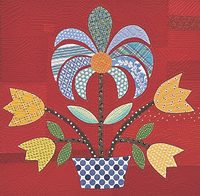
Quilting reaches back before recorded history. Quilts were made in the shadows of the Pyramids. In America, though quilts are often associated with Colonial times, they were actually rather rare. Early American homemakers had their hands full with spinning, weaving, and sewing and had little time for quilting. Blankets and woven coverlets made better use of their time, and so seamstresses turned to fine needlework mainly to display their creativity and skills.
 As the industrial revolution made commercially-woven cloth and thread cheaper and more readily available, quilting began to grow as a popular home art form. Further developments, including the introduction of the first practical sewing machines, also played a part. So did a war.
Quilting for the War Effort
In the 1850s, quilts were made to raise money to support the growing abolitionist movement in the North, and when war came in 1861, women on both sides of the conflict made quilts to send to their soldiers in the field and fancy quilts to sell at auctions to raise money for the war effort.
Most of these quilts were practical things, intended to serve a specific purpose other than decoration. Quilts were made from old bed coverings. Two bedspreads could be transformed into three quilts to cover the narrow army cots. In the South, despite an abundance of cotton, the U.S. Navy’s blockade of Southern ports made commercial cloth scarce as the war progressed, and the women of Dixie had to dig out their grandmothers’ spinning wheels and home looms and set to work before they could make a quilt.
The Crazy Quit
In the latter half of the 19th Century, quilting became more popular than ever, serving both practical and artistic needs for many. The best-known style of the era was the Crazy Quilt, made up of abstract patterns sewn together. Magazines had contests for quilters, and many of the “crazies” ended up as wall hangings or throws, rather than on beds.
Interest in quilting in America, as well as in American quilts, has continued to grow through the 20th and into the 21st Centuries. The American Quilt Study Group was formed in 1980 to further research quilts old and new. You can learn more at their Website, www.americanquiltstudygroup.org/.
Another group, Women Folk, has a site devoted to quilts and quilt history and offers a list of links and articles on both. See www.womenfolk.com